


Rhinoplasty (Nose Surgery) in Singapore

Dr Leo Kah Woon
Consultant Plastic & Reconstructive Surgeon
MBBS (Singapore), MMed (Surgery) (Singapore), MRCS (Edinburgh), FAMS (Plastic Surgery)
Many people have concerns about the appearance or function of their nose. Some feel their nose is out of proportion with their facial features, while others experience breathing difficulties or wish to restore the nose following an injury. In order to help their patients address these concerns, many plastic surgeons utilise rhinoplasty, a surgical procedure meant to reshape the nose.
Understanding how rhinoplasty works, the concerns it can address and what to expect throughout treatment can help you make a more informed decision about your care.

What Is Rhinoplasty?
Rhinoplasty, commonly known as a nose job or nose surgery, adjusts the underlying structures of the nose to change its shape, support or function. Depending on the patient's concerns, this may involve refining the nasal bridge, adjusting the nasal tip, narrowing the nostrils, correcting asymmetry or improving structural support for better airflow.
The procedure may involve the nasal bone, cartilage, soft tissue or skin, with the surgical approach planned according to the patient's anatomy and desired outcome. Since small changes to the nose can affect overall facial balance, rhinoplasty requires careful planning to achieve results that look natural and function well. No two cases are alike, and each patient will have a customised treatment plan specially crafted for them.
What Concerns Can Rhinoplasty Address?
Rhinoplasty can be performed to address cosmetic, functional and reconstructive concerns involving the nose. Following a detailed assessment of your nasal anatomy and treatment goals, your plastic surgeon will determine whether the procedure is appropriate for your individual needs.
Cosmetic Concerns
: Refining features such as a flat nasal bridge, dorsal hump, bulbous or drooping nasal tip, wide nostrils or a crooked nose to improve facial balance.Structural Concerns
: Correcting underlying nasal structures that affect the shape, stability or support of the nose.Functional Concerns
: Improving breathing difficulties caused by structural abnormalities that contribute to reduced airflow or nasal obstruction.Congenital Conditions or Trauma
: Restoring the appearance and function of the nose following birth defects or injuries.
What Are the Benefits of Rhinoplasty?
The benefits of rhinoplasty extend beyond changes to the appearance of the nose. By addressing concerns that affect facial balance or nasal function, the procedure can improve both confidence and day-to-day quality of life.
Improved Facial Harmony
: A nose that is better proportioned to your facial features can create a more balanced overall appearance.Greater Breathing Comfort
: Patients undergoing functional rhinoplasty may experience improved airflow and greater comfort during everyday activities.Long-Term Structural Support
: Correcting underlying structural issues can provide lasting improvements in both nasal appearance and function.Greater Confidence
: Many patients feel more comfortable with their appearance after achieving results that align with their aesthetic goals.
Who Should Consider Rhinoplasty?
Rhinoplasty may be suitable if you:
- Feel your nose is out of proportion with the rest of your facial features.
- Wish to refine concerns such as a flat nasal bridge, dorsal hump, bulbous nasal tip, wide nostrils or a crooked nose.
- Experience breathing difficulties caused by structural abnormalities within the nose.
- Have sustained a nasal injury that has changed the appearance or function of your nose.
- Were born with a congenital nasal condition that affects the shape or function of your nose.
We provide a wide range of procedures to enhance the form and function of the nose with natural-looking outcomes.
For a personalised consultation, please reach out to us today.
'%3e%3cpath%20d='M23.3806%2017.7994L27.0353%2014.1943C27.1565%2014.0748%2027.2252%2013.912%2027.2264%2013.7418C27.2276%2013.5716%2027.1611%2013.408%2027.0415%2013.2868L23.4365%209.63208C23.3474%209.54145%2023.2334%209.47931%2023.1089%209.45353C22.9845%209.42776%2022.8552%209.43952%2022.7375%209.48732C22.6197%209.53511%2022.5188%209.6168%2022.4475%209.72202C22.3763%209.82723%2022.3378%209.95124%2022.3371%2010.0783L22.3176%2013.0667L1.17973%2012.9212L1.17095%2014.2062L22.3088%2014.3498L22.2875%2017.3381C22.2865%2017.4652%2022.3232%2017.5897%2022.393%2017.6959C22.4628%2017.8021%2022.5626%2017.8852%2022.6797%2017.9346C22.7968%2017.984%2022.9259%2017.9975%2023.0507%2017.9734C23.1755%2017.9494%2023.2903%2017.8888%2023.3806%2017.7994Z'%20fill='%23D0A35B'/%3e%3c/g%3e%3cdefs%3e%3cclipPath%20id='clip0_6509_1595'%3e%3crect%20width='19.251'%20height='19.251'%20fill='white'%20transform='translate(27.4932%2013.7437)%20rotate(135.392)'/%3e%3c/clipPath%3e%3c/defs%3e%3c/svg%3e)
How Is a Rhinoplasty Procedure Planned?
Rhinoplasty is not a one-size-fits-all procedure. During your consultation, your plastic surgeon will evaluate your nasal anatomy, facial proportions, skin thickness and any functional concerns, while discussing your aesthetic goals and expectations. Based on this assessment, your surgeon will determine the most appropriate surgical approach and whether additional techniques, such as cartilage grafting or structural support, are needed to achieve the desired result. The two main surgical approaches used in rhinoplasty are closed rhinoplasty and open rhinoplasty.
Closed Rhinoplasty
Closed rhinoplasty, also known as endonasal rhinoplasty, is considered the most common and least invasive approach to nose surgery. It involves accessing the bone and cartilage through incisions created inside the nostrils, which results in no visible external scars and less numbness and irritation post-surgery.
This approach is commonly used when the planned changes can be achieved without extensive exposure of the nasal structures.
Open Rhinoplasty
Open rhinoplasty involves a small incision across the columella, the strip of tissue between the nostrils. This allows the surgeon to lift the nasal skin and access the underlying bone and cartilage more clearly. It is often used for more complex cases, such as significant reshaping, reconstruction or revision rhinoplasty. The incision is placed discreetly and typically becomes less noticeable as it heals.
Though more invasive, open rhinoplasty is considered more effective in treating more serious cases, such as disfigurements, because of the better visibility it provides to the surgeon. The recovery period will be longer than in closed rhinoplasties and may cause temporary swelling and bruising.
What Is the Rhinoplasty Process Like?
In order to carry out a successful rhinoplasty procedure, your surgeon will need to carry out meticulous planning, tailored to your anatomy and treatment goals.
Consultation and Surgical Planning
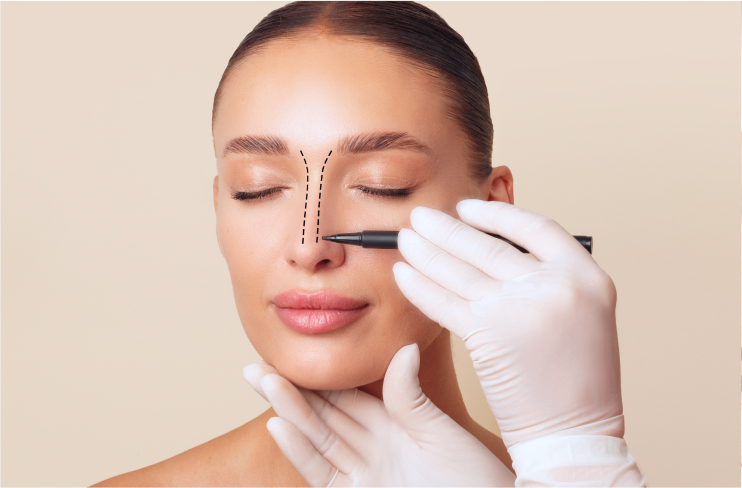
Your consultation begins with a discussion about your concerns, medical history and treatment goals. Your plastic surgeon will examine your nasal anatomy, assess your facial proportions and recommend an appropriate surgical approach. This is also an opportunity to discuss the expected outcome and find out whether additional techniques may be required.
Preparing for Surgery
On the day of surgery, you will be admitted and prepared for the procedure. Rhinoplasty is typically performed as a day surgery under general anaesthesia or sedation, depending on the planned procedure. Once the anaesthesia has taken effect, the surgeon begins the operation.
Reshaping the Nose
Using the planned open or closed approach, your surgeon carefully reshapes the underlying bone and cartilage to achieve the desired aesthetic and functional outcome. Depending on the procedure, cartilage grafts or implants may be used to provide additional support, improve projection or restore the nasal structure. The surgery typically takes around 2 hours, although this may vary depending on the complexity of the procedure.
Completing the Procedure
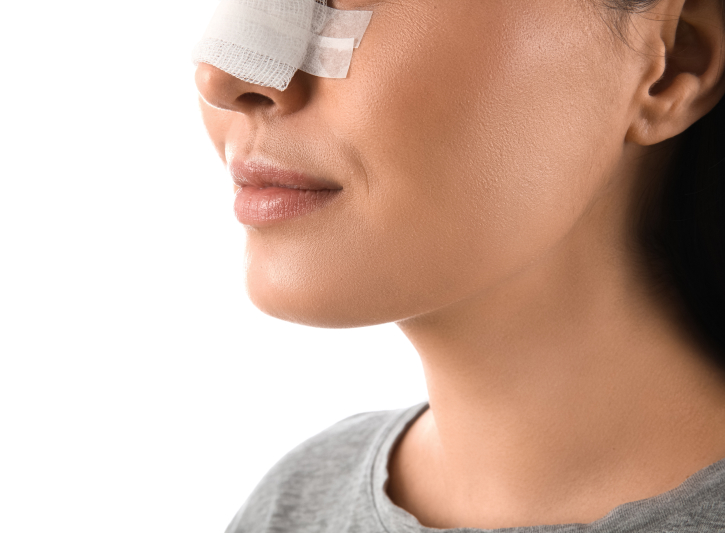
Once the planned changes have been completed, the incisions are closed and the nose is supported with dressings or a splint to protect its new shape during the initial stages of healing. You will then be transferred to the recovery area for routine monitoring before being discharged according to your surgeon's advice.
Rhinoplasty
Recovery Timeline
Following rhinoplasty, a nasal splint and dressings are usually applied to protect the nose and support its new shape during the initial stages of healing.
Swelling, bruising and mild discomfort around the nose and eyes are common during the first few days and gradually improve over time. If an open rhinoplasty has been performed, stitches at the columella are typically removed after about 7 days, while stitches at the alar, if required, are generally removed after 10–14 days.
Most patients are able to return to light daily activities within 1–2 weeks, although strenuous exercise and activities that could impact the nose should be avoided until advised by your surgeon. Regular follow-up appointments are arranged to monitor healing and ensure your recovery is progressing as expected.
Results You Can Expect After Rhinoplasty
Rhinoplasty is designed to achieve lasting improvements in both the appearance and, where appropriate, the function of the nose. As swelling gradually settles, the nose becomes more refined and proportionate to the rest of the face, creating a balanced and natural-looking result.
Patients who undergo functional rhinoplasty may also notice improved breathing as the nasal passages heal. Beyond the physical changes, many people feel more confident in their appearance and no longer feel self-conscious about features that previously drew unwanted attention.
What Are the Potential Risks of Rhinoplasty?
Like any surgical procedure, rhinoplasty carries some potential risks, including:
- Bleeding
- Infection
- Allergic reaction to anaesthesia
- Numbness
- Skin discolouration
- Nosebleeds
- Difficulty breathing
- Improper healing or noticeable scarring
However, these complications are unlikely in the hands of an experienced surgeon and can very often be well-managed.
Choosing the Right Specialist for Rhinoplasty
Rhinoplasty is a highly individual procedure that requires careful planning to achieve natural-looking results while preserving or improving nasal function where appropriate. Choosing an experienced plastic surgeon helps ensure your treatment is tailored to your anatomy, facial proportions and personal goals.
At Dr Leo Aesthetic Plastic & Reconstructive Surgery, care is led by Consultant Plastic & Reconstructive Surgeon Dr Leo Kah Woon, who has extensive experience in modern cosmetic surgery and facial aesthetic procedures. Every rhinoplasty is carefully planned by Dr Leo to create balanced results that complement each patient's unique facial features.
If you are considering rhinoplasty to refine the appearance of your nose, improve breathing or restore the nose following an injury, contact us today today to arrange a personalised consultation.
FAQs About Rhinoplasty (Nose Surgery)
Our Rhinoplasty Surgeon in Singapore

Dr Leo Kah Woon
Consultant Plastic & Reconstructive SurgeonMBBS (Singapore), MMed (Surgery) (Singapore), MRCS (Edinburgh), FAMS (Plastic Surgery)
Dr Leo Kah Woon is a consultant plastic & reconstructive surgeon with extensive experience in modern cosmetic surgery and facial aesthetic procedures. He takes an individualised approach to rhinoplasty, carefully evaluating each patient's nasal anatomy, facial proportions and treatment goals to achieve results that complement the overall harmony of the face.
Dr Leo's commitment to meticulous surgical planning and contemporary techniques allows him to tailor each rhinoplasty procedure to the patient's unique anatomy while striving for natural-looking, balanced outcomes. In addition to his clinical practice, Dr Leo is regularly invited to speak at local and international medical conferences, where he trains fellow doctors and shares his expertise in aesthetic plastic and reconstructive surgery.