


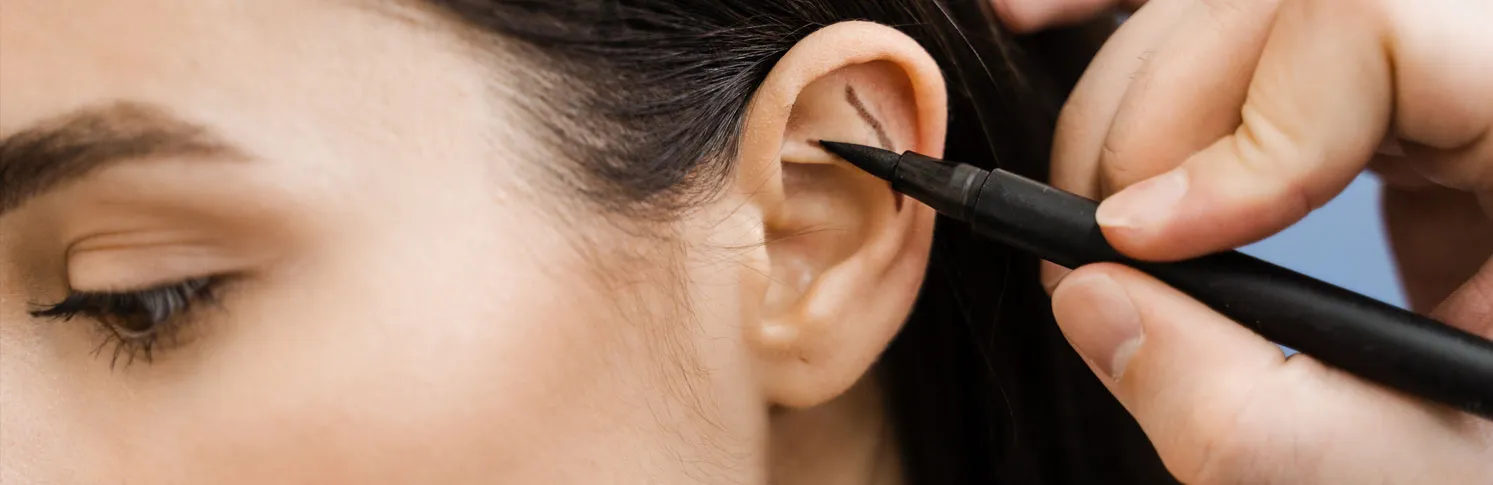

Structural irregularities in the ear are often caused by a mechanical failure of the ear cartilage to fold correctly or a loss of tissue integrity in the lobe. Identifying the specific anatomical site of the deformity is the first step toward a targeted clinical solution that ensures a stable and balanced result for the patient.
The different types of cosmetic ear procedures include otoplasty for protrusion, earlobe repair for split tissue, and complex reconstruction for congenital microtia. These surgical interventions focus on correcting structural imbalances in the external ear to restore a natural-looking proportion to the head without affecting the internal hearing mechanism.
Otoplasty for Protruding Ears: Correcting the Antihelical Fold
The most common cause of protruding ears is the absence or underdevelopment of the antihelical fold, which causes the outer rim of the ear to push away from the scalp. Correcting this anatomical failure through otoplasty involves a clinical technique known as ear pinning, which physically recreates the fold to pull the auricle into a balanced position. This structural correction is achieved through a combination of cartilage manipulation and precise tissue reduction.
Cartilage Reshaping and Suture Placement
The primary mechanism for correcting protrusion is the restoration of the antihelical fold through the use of permanent internal sutures. By carefully folding the cartilage, the surgeon manually creates a defined ‘Y’ shape that allows the ear to sit at a clinically ideal angle against the side of the head. This mechanical adjustment provides the necessary structural tension to keep the ear in a natural position permanently.
Conchal Bowl Reduction
In cases where the deep bowl of the ear is excessively large—a condition known as conchal hypertrophy—a small section of cartilage is removed to reduce the overall projection. This reduction ensures that the ear does not appear to push outward from the scalp even after the antihelical fold has been successfully recreated, resulting in a more balanced profile.
Surgical Access and Scar Management
To ensure a discreet aesthetic result, surgical access is strictly limited to the posterior auricular crease, which is the natural fold located behind the ear. This strategic placement allows the surgeon to perform extensive structural changes to the cartilage and skin envelope while ensuring that any resulting scars remain entirely hidden from external view.
Ear Lobe Repair: Addressing Mechanical Tissue Failure
The clinical need for ear lobe repair typically stems from a mechanical failure of the soft tissue, often caused by the long-term wearing of heavy jewellery or sudden trauma that results in a split lobe. Unlike cartilage-based procedures, this surgery focuses on the excision of scarred tract tissue and the precise realignment of the skin margins to restore a natural lobe contour.
Earlobe Rejuvenation for Ageing Tissue
Over time, the loss of collagen and subcutaneous fat can cause the lobes to appear elongated or deflated. A clinical combination of minor excision and dermal fillers can restore a firmer, more youthful volume. This restorative process addresses the thinning of the soft tissue, ensuring the lobe remains structurally sound enough to support earrings without sagging or further stretching.
Closure of Gauged or Stretched Piercings
Correcting a gauged ear requires a complex rotational flap technique to remove the excess stretched skin and reconstruct a circular, natural lobe shape. This mechanical repair involves rearranging the remaining healthy tissue to fill the void left by the gauge, ensuring the lower ear profile is restored to its original proportions and clinical integrity.
Microtia and Ear Reconstruction

Microtia is a congenital condition where the external ear is severely underdeveloped or absent, requiring a multi-stage reconstructive roadmap to build a new auricular framework. This complex clinical process focuses on creating a structurally sound ear that matches the patient's existing ear in height, orientation, and anatomical detail. By utilising advanced grafting techniques, the surgeon can restore the natural projection and contour of the auricle for a stable and permanent result.
Rib Cartilage Grafting vs Synthetic Frameworks
The surgeon may use the patient’s own costal rib cartilage to carve a bespoke ear frame or utilise a biocompatible synthetic implant as the foundation for the new ear. While rib cartilage is a living autologous tissue that integrates fully with the body, synthetic frameworks offer a highly consistent shape and often require fewer surgical stages to achieve the final projection of the auricle.
Skin Expansion and Grafting
To cover the new framework, the surrounding skin is often gradually expanded or a thin skin graft is harvested from a donor site. This ensures the new ear has the necessary blood supply and skin tension for long-term survival, preventing the underlying framework from becoming exposed or distorted during the healing process.
Correcting Ear Asymmetry and Helical Rim Deformities
Ear asymmetry occurs when one ear significantly differs in shape, size, or position from the other, often due to minor helical rim deformities like Stahl’s Ear or Lop Ear. Addressing these irregularities requires a bespoke surgical plan to adjust the tension of the cartilage and ensure bilateral harmony across the midline of the face.
Structural corrections for asymmetry focus on recreating the natural curvature of the helical rim or adjusting the height of the auricular attachment. By performing precise cartilage scoring or repositioning, the surgeon can align the ears to create a more uniform appearance without altering the patient's internal hearing mechanisms.
This clinical approach also ensures that both ears are balanced in proportion and orientation, providing a stable aesthetic result that complements the overall facial structure.
Resolving Cosmetic Ear Concerns with Dr Leo Plastic Surgery
Cosmetic ear procedures provide a clinical solution for structural irregularities, ranging from common protrusion to complex congenital microtia. By addressing the specific mechanical failure of the cartilage or soft tissue, these surgical interventions restore anatomical balance and improve the overall facial profile.
At Dr Leo Plastic Surgery, we prioritise evidence-based techniques to achieve precise auricular correction. Dr Leo Kah Woon and his team provide comprehensive evaluations to identify the most effective reconstructive or aesthetic approach for each patient's unique anatomy.
If you’re seeking professional guidance on ear reshaping or tissue repair, book an appointment with us today to discuss your clinical options and develop a personalised treatment roadmap.
Frequently Asked Questions About Cosmetic Ear Procedures
At what age can a child safely undergo otoplasty?
Children can safely undergo otoplasty from age five to seven, as the ear has reached approximately 90% of its adult size and the cartilage is stable enough to hold sutures. Performing the procedure before primary school helps avoid social distress and ensures the cartilage is still pliable for optimal reshaping.
What is the typical recovery timeline for ear pinning surgery?
Most patients return to school or sedentary work within one week, though a protective headband must be worn at night for one month. While initial swelling subsides in ten days, strenuous exercise and contact sports should be avoided for at least six weeks to protect the internal structural repairs.
Can a cosmetic ear procedure affect my hearing?
No, cosmetic ear procedures do not affect hearing because the surgery is strictly limited to the external cartilage and skin. The internal ear canal, eardrum, and auditory nerves remain entirely untouched, ensuring that your hearing remains perfectly preserved while the outer ear shape is being corrected.